

Panacea
On prayer, silver bullets, and the longing to escape the unbearable weight of being human.

Before 2010, mindfulness was not so cool. I remember one morning circa 2009 when my sister, a GP, was staying at my flat in London. She got up in the morning and saw me sitting on my meditation chair in a corner of the room with my eyes closed just sitting still…to which she proclaimed:
“What the hell are you doing, weirdo?”
Then came the mindfulness revolution.
The research behind mindfulness expanded, and companies like Headspace began to rebrand meditation from ‘that thing weird hippies do’, to something that is good for your health, ‘a gym for the mind’ as they used to call it. The hype grew and grew, and soon mindfulness was being introduced in boardrooms, in hospitals, in schools, with soldiers, prisoners, pensioners. Around 2014, my sister no longer thought mindfulness was weird - she invited me to come and teach her fellow doctors how to meditate.
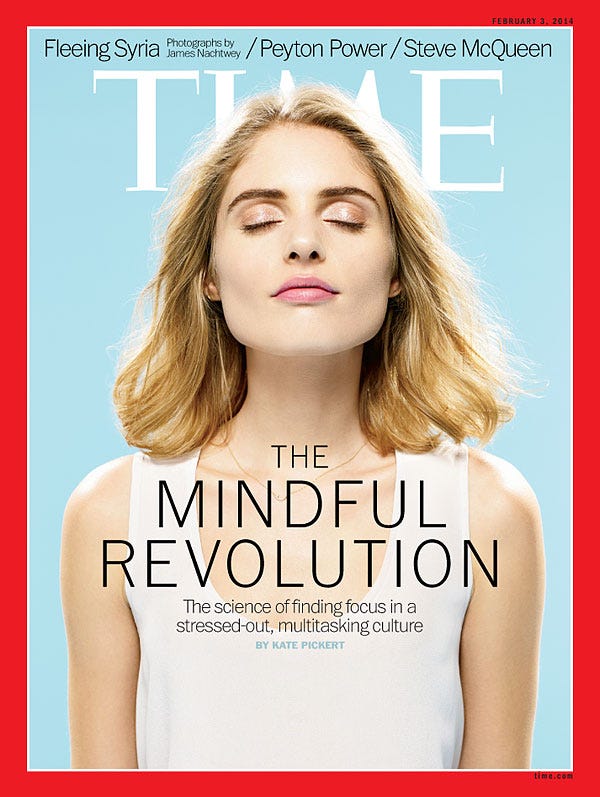
The mindfulness bubble continued to inflate for years, until eventually (inevitably) the cracks began to appear, and mindfulness started to lose its glow as a universal remedy, beginning instead to attract a more sceptical gaze. Ron Purser wrote a book called “McMindfulness” in which he crystallised a critique that had been growing for some time: modern mindfulness, stripped of ethics and packaged for consumption, was being sold back to the very institutions generating the stress it was supposed to relieve. Critics began asking whether mindfulness was really helping people wake up, or simply helping them cope more efficiently with impossible conditions. At the same time, research began to complicate the picture, with studies suggesting that mindfulness could sometimes be harmful, and that school-based programmes were not always improving students’ mental health, and in some cases may even have been doing more harm than good.1
How can something go from such hype, a cure-for-all, to such a hard landing back to earth?
Well, we have been here before, and we will be here again. Because human beings are desperate. Desperate for something that will finally quiet that ache - a magic pill, a silver bullet, a system, a practice, an ideology, a leader, a supplement, a technology, or a breakthrough that will finally and forever relieve us of the unbearable weight of being human.
We are, perhaps eternally, vulnerable to the fantasy of panacea.
2.
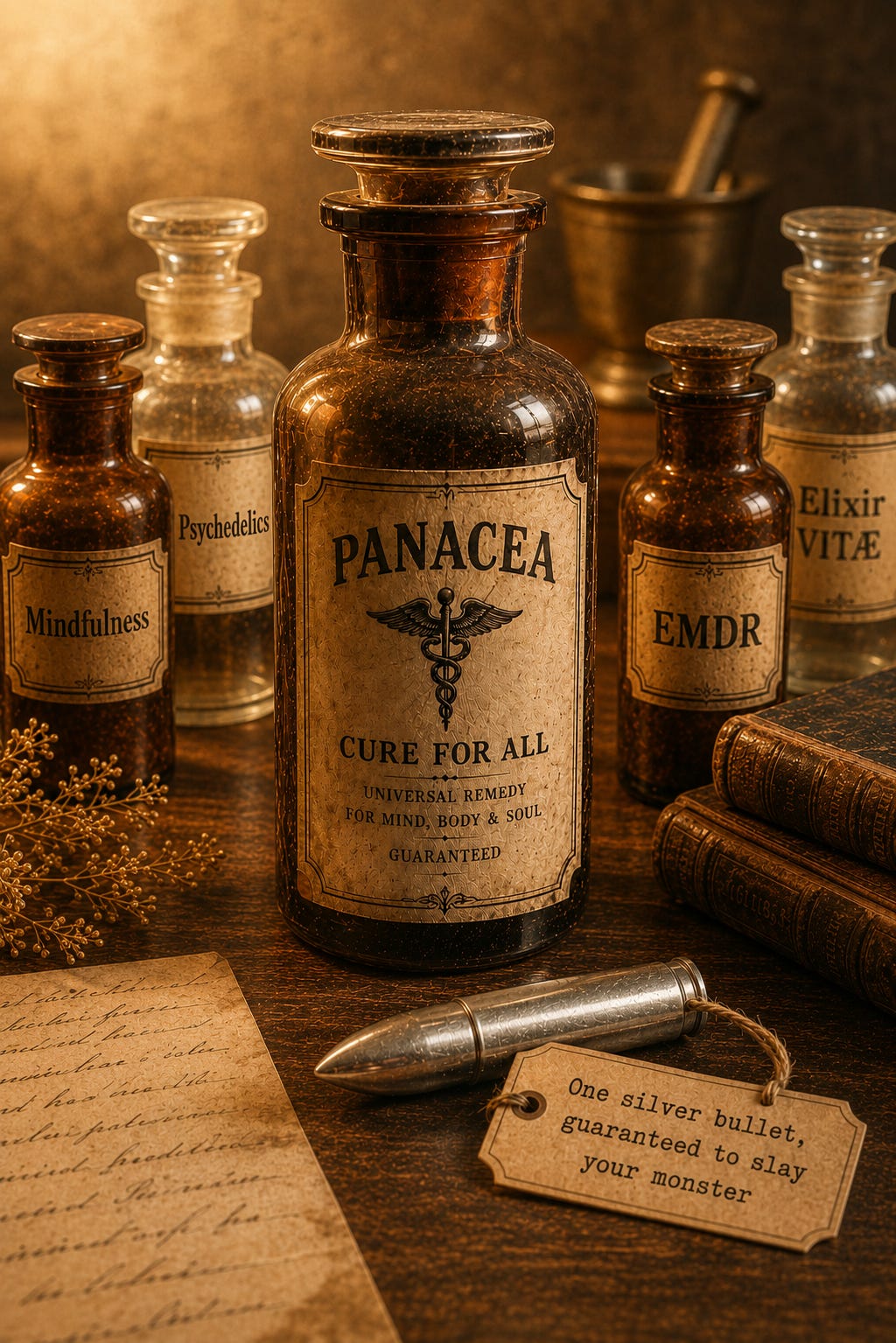
Panacea was the goddess of universal healing in ancient Greek mythology. She was believed to have a remedy for any ailment, a cure for any condition. She is the archetype of the human hunger for total relief, for the fantasy that somewhere there exists a single potion that can tidy up the irreducible complexity of suffering.
And she travels in realms beyond the worlds of healing and medicine. I see Panacea when I see the latest new political figure promising eternal salvation, and everyone whether right or left getting whipped up into a frenzy of excitement - finally someone who can purify the human soul of all evil.
Of course, some leaders are wiser than others, some therapies are better than others, some practices genuinely help. The problem begins when our minds transform these partial truths into fantasies of total salvation, when our desperation causes us to hand over too much power, or certainty, or faith into something or someone that cannot possibly carry the weight we place upon it. And paradoxically, it is this very longing for absolute relief that can actually make us suffer more.
According to legend, the original silver bullet was used to kill a man-eating beast impermeable to other weapons. The silver came from recycled medals of the Virgin Mary, melted down by the French hunter Jean Chastel and loaded into a gun. Even in this myth, we see a tendency to recycle our faith into fantasies of total relief.
So why do we keep getting trapped in these fantasies, even though they seem to make us suffer more?
Our desperation for a panacea makes sense when we slow down to consider the nature of human suffering.
It can feel really fucking hard to be a human being. To love people so deeply, and to know you will lose them. To lie awake at 3am, drenched in sweat, heart beating like a pneumatic drill against your chest, replaying conversations, mistakes, futures that haven’t happened yet. To look in the mirror and see time leaving its fingerprints all over your face, and to know exactly how this story ends. To carry the lonely terror that you may have wasted this one precious life on the wrong work, the wrong relationship, the wrong way of being. To experience moments of beauty so profound they break your heart, especially because we know they cannot last. To desperately want certainty in a world where relationships change, bodies fail, economies collapse, people die, and no one can ever tell you for sure that everything will be okay.
All of this creates a uniquely human form of suffering, with countless different expressions, feeding our desperate yearning for something, pleeease God anything, that might finally take the pain away. Perhaps this is one of the deepest roots of prayer itself: the raw human cry that rises when we come face to face with our helplessness, our fragility, our inability to control the fact that we love, lose, age, break, grieve, and die. I think of the baby’s cry that brings it back into contact and hopefully comfort with mother. Beneath many of our prayers, ideologies, and panaceas lies a desperate longing not to feel so alone with the tenderness and the terror of being alive.
So if you (like me) have ever found yourself longing for a silver bullet, a cure, a technique, a therapist, a guru, a political movement, a spiritual breakthrough, a person who will finally tell you they know the way out, then I am writing this piece directly to you. Through these words, and whatever tendrils may reach out through this page toward your heart, I want to offer some kind of reassurance, reminding you that in this desperate longing to be free from suffering, you are not alone.
The baby that cries does not need a silver bullet. They just need to be held. They need a felt experience that they don’t have to face this overwhelming reality entirely alone. And this is where I believe many modern approaches to healing go wrong. We keep searching for the perfect technique, the ultimate breakthrough, the final cure, while overlooking the ancient conditions that have helped human beings survive suffering for millennia: community, shared ritual, friendship, loving touch, moments of shared vulnerability.
Panacea thinking also tends to search for a single answer. But most meaningful healing seems to happen differently, more subtly: a conversation here, grief finally expressed there, a good night’s sleep, a body slowly learning safety again, an unexpected moment of honesty, a friendship that helps us carry life differently.
We will never find the silver bullet that finally frees us forever more from the vulnerability of being human. But every now and then, we can find solace in the discovery that, even in the dark, someone is still there when we cry out.
I'd love to know in the comments if you relate to this at all? What have been your silver bullets? The thing(s) or people you handed too much faith to, hoping it would finally be the one?
https://www.mindful.org/new-study-finds-school-based-mindfulness-program-doesnt-work-and-may-evenbe-harmful-for-some-children/